
Custom Contact Pins
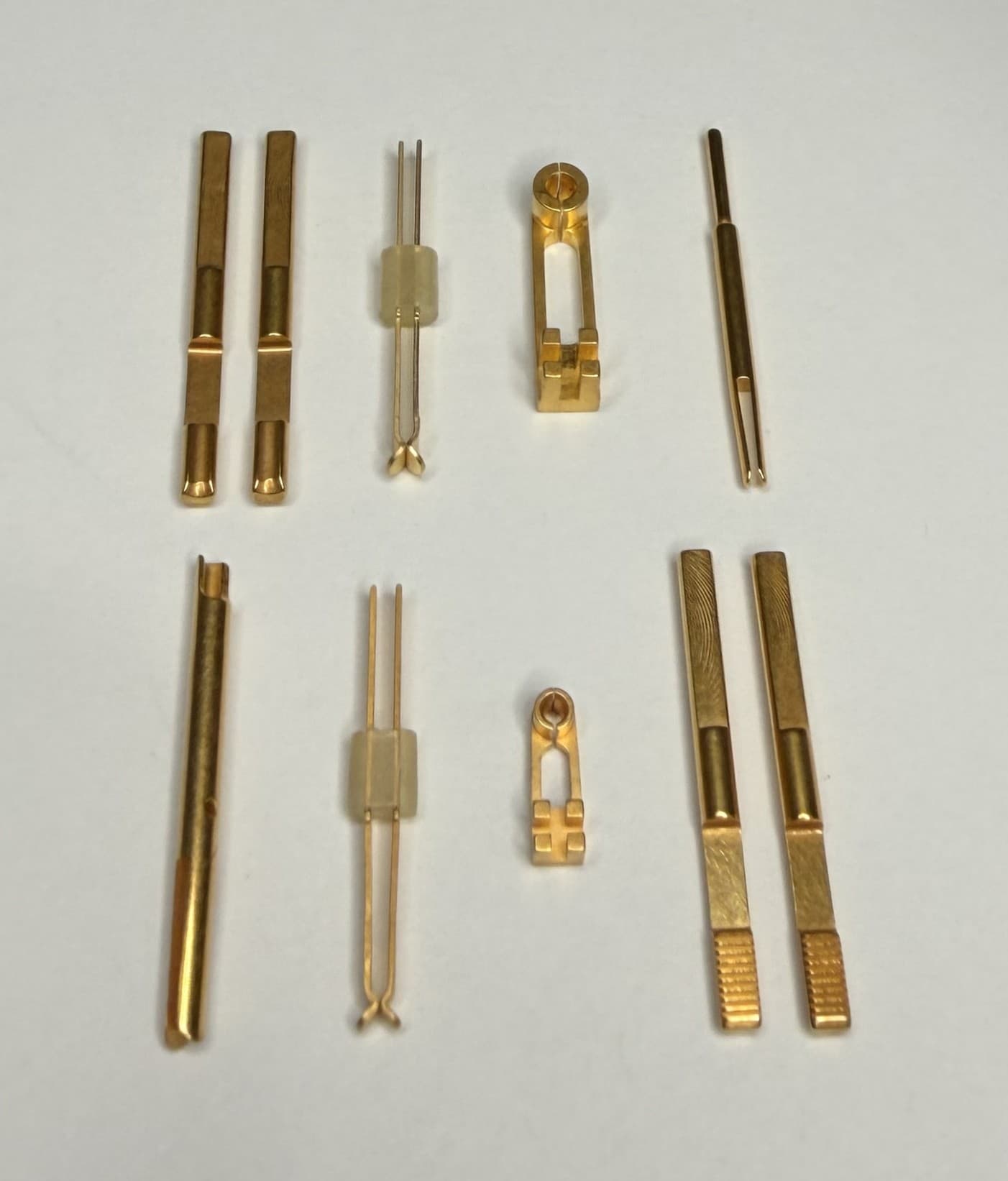
Tooltronics sports production of three types of custom contacts. Our history is one of innovation and precision.
In 1995, Tooltronics began designing and manufacturing custom test sockets for the power electronics and relay industries. A critical component of these sockets is the Kelvin contact pin. After extensive research, we found that existing suppliers could not provide a solution that met our requirements for orientation accuracy, current capacity, and reliable mechanical retention. As a result, Tooltronics developed and began manufacturing our own Kelvin contact technology.
Our Kelvin contacts were designed to solve three key challenges common in relay and power device testing:
- Precise pin orientation for reliable contact with rotated hook pins and square or rectangular device leads
- Higher current capability for demanding power electronics testing
- Stable vertical retention without the need for epoxy or adhesives
To achieve this, Tooltronics uses 0.015" thick Beryllium Copper for improved current capacity and durability. Our Kelvin pins also utilize an obround-shaped injection molded insulator, which ensures precise orientation and secure positioning compared to traditional round insulator designs.
Contacts are manufactured from Beryllium Copper and finished with 30 microinches of gold over 200 microinches of boron nickel, providing superior conductivity, corrosion resistance, and long service life in demanding test applications.
LPK Kelvin Contacts
Our standard LPK Kelvin contact pins are widely used in relay and semiconductor test sockets.
- LPK-100 – Designed for 0.100" minimum spacing
- LPK-125 – Designed for 0.150" minimum spacing
These contacts are available as individual components or integrated into custom test sockets and fixtures.
High Current Kelvin Contacts
For higher power applications, Tooltronics offers High Current Kelvin Contacts rated up to 50 amps per side. Available options can accommodate device leads ranging from 0.025" to 0.080", providing reliable performance for demanding power semiconductor testing.
High Current PCB Mountable Contacts
Our High Current PCB Mountable Contacts provide a reliable electrical interface directly to a printed circuit board. These contacts allow devices to be inserted and tested without permanent soldering, making them ideal for development, qualification, and production testing environments. A wide range of sizes and configurations are available.
MPS Solid Pin (Non-Kelvin) Contacts
When space is limited and Kelvin sensing is not required, MPS Solid Pin contacts provide a compact and reliable alternative. These contacts are available with either a turned tail or solder cup termination, offering flexibility for various test socket and fixture designs.
Key Features
- Precise orientation
- High current capabilities
- Vertical retention without adhesives
- Custom design and manufacturing
Precision Custom Contact Pins for Demanding Applications
Applications for Custom Contact Pins
Tooltronics, Inc. custom contact pins are engineered for demanding electronic test applications requiring precision alignment, reliable electrical performance, and long service life.
Common applications include:
Power relay testing
DC-DC converter testing
Aerospace & defense electronics
High-current production testing
Burn-in & validation fixtures
Automated test equipment (ATE)
Why Choose Tooltronics, Inc.
Precision CNC machined for repeatability and durability
Made in USA manufacturing
Family-owned and operated since 1962
Worldwide customer support
Long service life for demanding production environments
Replaceable contact systems for simplified maintenance
LPK obround insulator design for precision orientation accuracy
Adhesive-free anchoring for secure retention and easier replacement
Custom engineering support for specialized applications
Custom Engineered Solutions
Tooltronics manufactures both standard and fully custom contact pin solutions for prototype, engineering, and production test applications. Multiple lead sizes, spacing configurations, and high-current options are available to support a wide range of electronic devices and test systems.
Request a Quote
Request a quote for your application
Discuss a custom contact design
Send us your device drawing for review
Contact our engineering team for technical support
Our team works directly with customers worldwide to develop reliable, precision-engineered contact solutions for demanding electronic test applications.
Need a Custom Solution?
Tooltronics specializes in custom engineering. Contact our team to discuss your specific testing requirements.
Contact Engineering